Going on holiday is a matter of more than just selecting a destination and booking a hotel. Passengers should also have routes, locations, information on how to get there, helpful places to stop and backup plans available. These details can be organized into a travel plan using Map guides ttweakmaps traveltweaks. They concentrate on maps as planning tools, as opposed to simple screens for navigation.
A helpful map can display a lot more than just roads. It can provide information to travelers about areas of interest, neighborhoods, distances to travel, and nearby services. It also can assist in developing a logical daily schedule. This can help to minimize unnecessary travel and enhance trip organization.
What Are Map Guides TTweakMaps TravelTweaks?
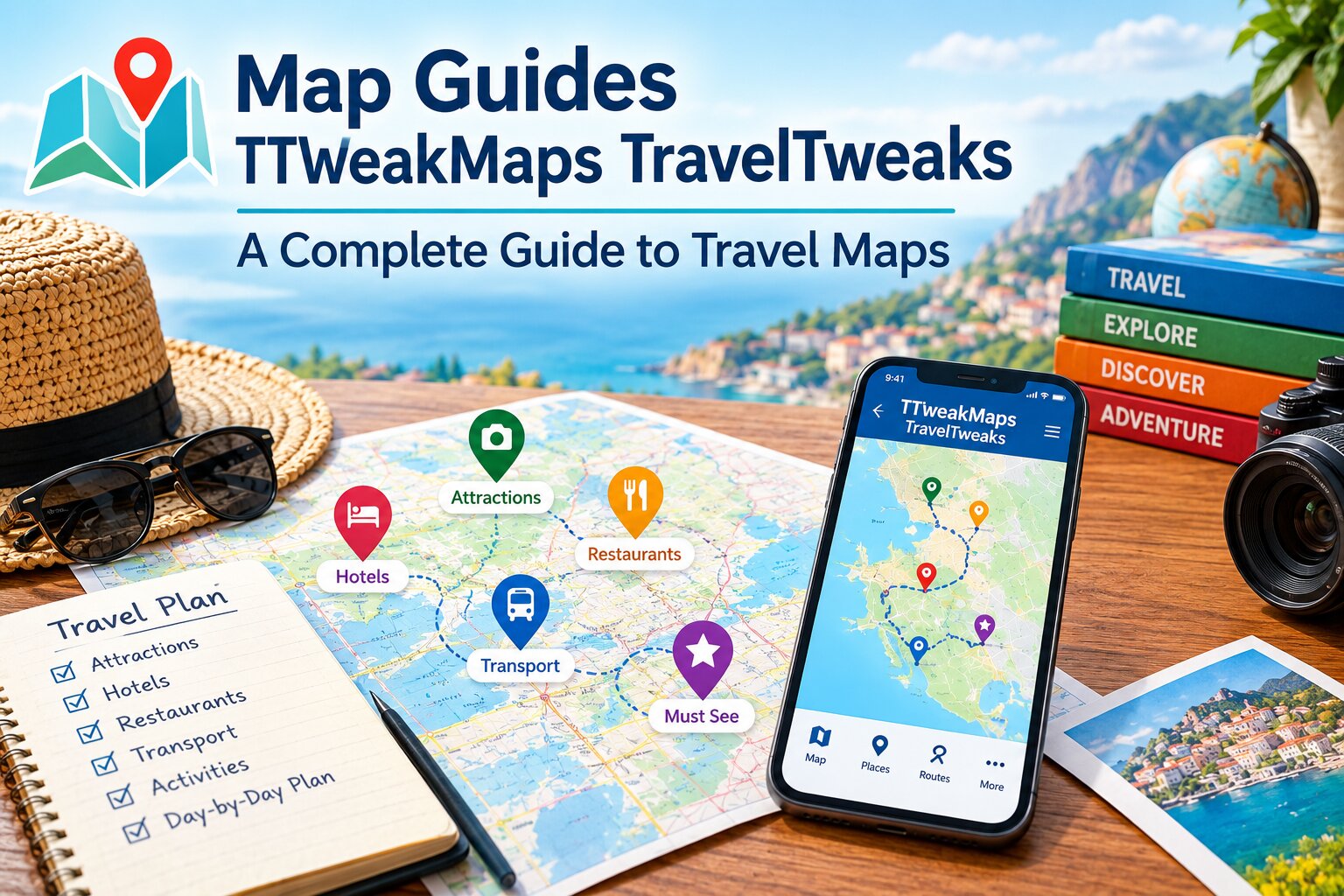
Map guides ttweakmaps traveltweaks are travel-oriented map guides which provide location data and practical planning suggestions. Descriptions available highlight route planning, Destination context, Custom pins, Notes and Organized travel information.
Traditional maps are primarily used to address one question. They indicate location.
A travel map guide can provide answers to several other questions. It can describe the context for that location and the relationships between places. It can also assist you to schedule multiple stops in a single trip.
This distinction is important if visitors are going to new cities. An attraction that is easy to find can waste a traveler’s time to get to another location nearby.
Those connections can be discovered in advance via a structured map.
Why Travelers Need More Than Basic Navigation
GPS software is useful for navigation. While directions are important, they do not necessarily generate an efficient travel plan, though.
Suppose you are going to take a city break which will last three days. Consider visiting museums, restaurants, markets, parks, etc., and historical sites. If the various places are visited individually, then backtracking can be avoided.
A mapping approach to planning can be used to cluster sites.
Attractions can be located within the neighborhood. These can then be scheduled for the same day. The method can help to decrease the time spent moving between activities.
Map guides ttweakmaps traveltweaks support this type of planning by encouraging travelers to look at destinations as connected areas.
How Map Guides Can Improve Trip Planning
The first step in planning a good trip is to know where you are going!
Don’t book everything right away, look at the map first. Determine the regions you wish to investigate. Then, look at the distance between key places.
Form geographical groups.
For instance, put museums in one category. Do not include restaurants/markets in another group. Differentiate outdoor activities from indoor attractions.
These can then be used to structure your daily schedule.
This approach helps to avoid one of the typical planning challenges. Visitors may make a choice for a popular attraction without taking location into account.
A map gives context to a visual. It demonstrates the relative distance between locations. It also aids travellers to identify transportation routes and hubs.
Using Custom Pins and Map Layers
Travel maps can be made more useful with custom pins. Hotels, attractions, restaurants, transport stations and emergency facilities can be marked during the trip.
It’s possible to create particular categories as well.
For example:
- Hotels
- Restaurants
- Attractions
- Shopping areas
- Transport stations
- Scenic locations
- Backup activities
It makes the map easy to understand.
Custom pins, layers, annotations and organized travel information are mentioned in some descriptions of TTweakMaps.
These elements can be used to develop an individual reference map.
A customised map will also lessen reliance on random notes. You can have key places in your itinerary organized, not stored in multiple apps.
Planning Routes Around Your Hotel
The place where you stay can be the determining factor of your entire trip.
Buying a room is all about convenience, and many travellers only consider its price or appearance. Location is also as important.
First, plot the location of your hotel. Next add your principal destinations.
Seek out areas of interest in close proximity to the hotel. Identify areas that are further away. Take into account public transport and walking distances.
This can determine if your lodging can suit your schedule. The hotel is in the center and it can decrease the amount of transportation required each day.
A far away hotel can save you money but makes traveling time longer. These can be contrasted prior to booking.
If you’re still doing your research on hotel discounts, then you can check out the discount code TTweakHotel to get more information.
Building a Day-by-Day Travel Map
The usefulness of a map is magnified when it is coupled with time. List places that are mandatory. Then try to guess the time needed at each location.
See their location on the map. Group nearby attractions together as far as possible. Do NOT schedule far away trips on the same morning and afternoon.
You could, for instance, go to a historic neighborhood in the morning. You could then go to some of the local restaurants or markets after.
This allows for a natural traffic flow. There should also be enough room for some breathing room between activities. Transportation delays and attraction visits may be caused by unexpected delays.
Having a flexible map is better for the job than having an overfilled schedule.
Using Maps for Short Trips
It is important to plan for short trips. The two-day visit doesn’t offer enough time. Triptees can’t afford too much transportation between sites.
Travelers can use the Map guides ttweakmaps traveltweaks to plan destinations by location, as well as by importance.
Take the most important things first. Mark them first. Then add secondary attractions around them.
This strategy is a way to safeguard the most significant experiences. Other plans can be developed. Include indoor activities for rainy days. Note restaurants in the vicinity of attractions.
Know how to get around in the main areas. This preparation may be helpful during the journey.
Using Maps for Road Trips
Road trips call for a different strategy. Distance is a key planning consideration. Driving time, fuel stops, lodging, meal plans, and sightseeing are all factors to consider when traveling.
If you have a long route, a map can be used to make it easier to split into manageable chunks.
Start by marking the starting point and final destination. Next, place large cadences in between.
Search for reasonable places to spend the night. Don’t bring needless long driving days about.
They should also be located at backup stops. Plans can change for the weather, traffic, closures and fatigue. The flexible map allows you to make more flexible route adjustments.
If possible, download information on maps for longer trips. This preparation may be useful when mobile phone connectivity is not available.
Understanding Local Geography
Maps are more than directions. They enable travellers to “read” the connections between destinations.
A city can have multiple different neighborhoods that were established. Every region may provide different attractions and travel conditions.
The character of a coastal district can be very unlike that of its business district counterparts in the interior. The width of the streets and the types of transportation available in a historic center may also vary.
By learning this geography, travellers know what to expect.
The Map guides ttweakmaps traveltweaks are focused on this aspect of a travel plan. They stimulate tourists to use a learning approach rather than traveling based on individual instructions.
Travelers can also gain an understanding of fundamental cartography principles to help them comprehend how maps portray geographic information.
Preparing for Offline Navigation
In certain instances transportation may negatively impact internet connectivity.
It might be weak at distant locations. Expensive data charges may also apply to travelers coming from abroad.
These can be minimized by preparing maps offline. Prior to check-out from the hotel, download the areas you will be traveling in if you have selected a map service that allows offline maps.
Don’t store other key addresses there either. Record where you will be staying and key transportation spots.
It is also important to have vital information written down. Technology can fail. Don’t let a lack of backup cause needless anxiety.
Combining Maps With Travel Research
Don’t use a map as a substitute for travel research. Check official tourism websites for up-to-date information. Please check attraction opening times prior to visit. Check with up-to-date sources for travel plans.
It’s also a good idea to check temporary restrictions.
Maps may provide location of interest, but things can change. The restaurant may have to shut its doors. Construction of a road can take place. The entrance to an attraction can be changed.
As such, always create a base plan using your map. Finally, double check information that relies on time before leaving.
Finding Hotels and Nearby Travel Deals
Accommodation is an important aspect of route planning. After knowing your travel program, you can compare hotels at your selected destinations. Consider proximity to attractions and transportation.
Avoid making your decision based on the overnight rate. Take into account the entire travel expense. A more affordable hotel might come with a higher cost of transportation each day.
Commute time may be shorter, if taken to a slightly different spot.
In addition, it has the ability to compare hotel offers prior to deciding to stay. If you are interested in the subject, check out the offers from TTWeakHotel guide.
This helps relate accommodation research with your travel map in general.
Common Mistakes to Avoid
Often, travelers make a number of mapping errors. The first error is that too many locations were added.
Having hundreds of pins on a map makes it difficult to use. Emphasize locations that are relevant to your travel plans.
The second error is to neglect travel time. Two such attractions can be adjacent to each other on a map. Walking conditions or routes of transportation may lengthen the trip.
The third error is having a rigid schedule.
Unpredictable delays are experienced in transit. Allow for adequate transitions between activities.
One error is the exclusive use of one digital source. Review vital information from trusted and up-to-date sources.
Lastly, don’t put personal, confidential data on public maps. Censorship of private addresses and irrelevant personal information before sharing a map.
How to Create a Practical TTweakMaps Travel Plan
It’s easy to produce a helpful map for your travels.
You have to select the destination.
Secondly, make your stay sign.
Third, add your must-see attractions.
Fourth, cluster neighborhoods together.
Fifth, determine means of transportation.
Sixth, make daily activity groups.
Seventh, as a nod to that, include restaurants and backup.
Lastly, check the entire trail.
Check for unessential backtracking. Review to see if each day is feasible.
This transforms a simple list of locations into a usable travel plan.
Who Can Benefit From Map Guides?
Travel planning via maps can assist various travelers. Maps can help guests with a new experience to navigate unknown places.
Families can plan attractions that are closer to home. Road trippers can break up lengthy trips into smaller chunks.
Solo travelers can indicate key services and back-up sites. Business travellers can make appointments around central areas.
Routes can be planned and key access points located for use outdoors. The primary advantage is that of organization.
The map is not a travel decision maker. Rather, it provides travelers with helpful geographic context.
Final Thoughts
If you know how destinations are linked, travel planning becomes easier. A map makes it easy to plan attractions, routes, where to stay and how to get there, and backup plans.
Map guides ttweakmaps traveltweaks offer a map-centered approach to this process. Features like custom pins, layers, annotations, route planning and the destination context are described in available guides.
The best way to combine helpful maps and up-to-the-minute travel data.
Research your place of destination before making a booking. Categorize the attractions that are close to the group together. Consider travel times and make alternative plans.
Check also critical information prior to travel. Your map is more than a navigational tool, it’s a product of careful preparation. It turns into an effective plan guide for your entire trip.
Frequently Asked Questions
1. What are map guides ttweakmaps traveltweaks?
Map guides ttweakmaps traveltweaks are travel-related map guides which organize destinations, routes, locations, and trip information.
2. How can map guides ttweakmaps traveltweaks help travelers?
For travelers, Map guides ttweakmaps traveltweaks will help them organize locations, group nearby attractions, plan routes, and understand destination geography.
3. Can map guides ttweakmaps traveltweaks help with road trips?
Yes. Use map based planning to plan stops, accommodation, attractions and driving sections.
4. Should travelers rely only on map guides ttweakmaps traveltweaks?
Travelers are advised to check up to date timetables, closures, travel details and local travel warnings at trusted sources.
5. Are map guides ttweakmaps traveltweaks useful for first-time travelers?
Yes. They are helpful for first time visitors to understand neighborhoods, attractions, routes and nearby facilities before visiting them.