Taking a trip includes a lot more than just picking destinations and reserving a hotel. Travelers should also have clear pathways, helpful places, plausible schedules, and contingency plans. Map Guide TTweakMaps by TravelTweaks is dedicated to using maps to actually help you plan your trips.
Directions are just one thing a digital map can do. It can assist you in finding out more about neighborhoods, arrange attractions, estimate distances, and make efficient day-to-day routes. It can also help to minimize needless travel from one place to another.
Map Guide TTweakMaps by TravelTweaks is based on the concept of improving travel maps. Travelers do not have to take a simple route, but can be educated about the destination beforehand. This can help one understand and explore unfamiliar places.
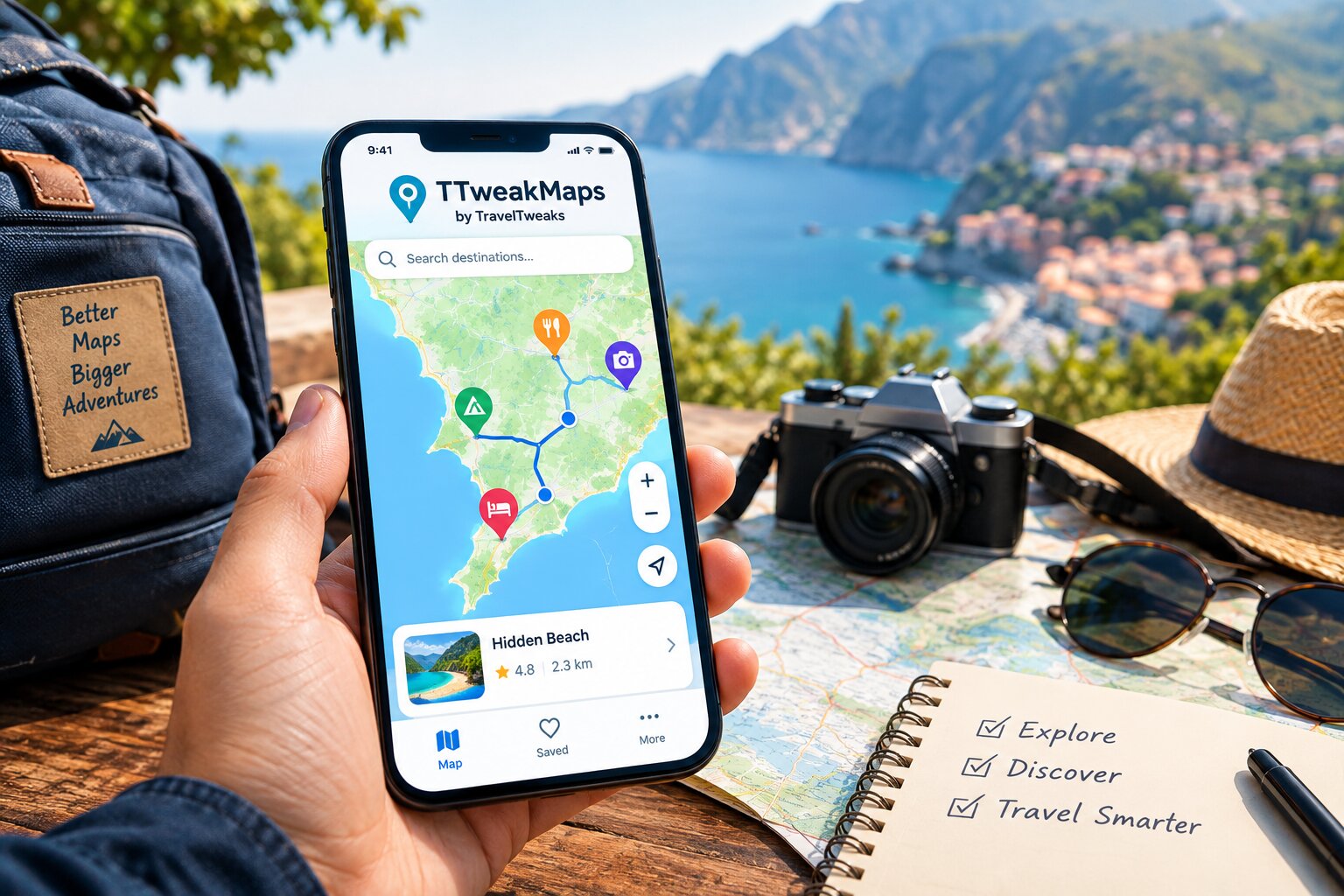
What Is Map Guide TTweakMaps by TravelTweaks?
Map Guide TTweakMaps by TravelTweaks offers a travel strategy in the form of mapping. The method links places, paths, events and real-life decisions around travelling.
In traditional navigation, you typically ask this question: How can I get to a place? A travel map guide can provide answers to several questions.
After making plans to visit a place, you can see some nearby attractions. You can search for hotel locations near major attractions. You can check transportation options prior to each day beginning as well.
This is an effective way for travellers who don’t like a planned trip. It is possible to have enough space for free exploration with the important details prepared.
Customization and the use of maps are the focus of TravelTweaks content. It teaches about route planning, map layers, researching destinations, and travel preparation.
Why Maps Matter Before a Trip
Flying or booking a hotel are common starting points for travellers. Typically, they look at the map of the destination quite late.
This can cause unnecessary issues. A hotel might be cheap, but it can be quite a distance from the activities you want to do. When a restaurant looks like it is close, check out walking routes. It will take longer to get to an attraction than you think.
The geographical context is provided by a map before you make those decisions.
Suppose there is a city with 5 attractions. One may have one attraction each day on a basic tour schedule. One map shows that 3 attractions are in the same district.
Then, you can go together to those 3 places. This is a straightforward change that helps save on transit time. It can also help make travel days more comfortable.
Building a Map Around Your Travel Priorities
Each traveller has their own priorities. There are those who think about attractions. Some are interested in food or shopping, nature or culture, or nightlife.
Those priorities should be evident in your map. First, make a list of destinations that you will undoubtedly visit. Add hotel and transportation point. Next, add optional locations that are interesting.
Don’t put all the attractions that you have found on the Internet. A map may be hard to read if too many locations have been saved. A focused map provides you with more information at the appropriate time.
Locations can also be added to a category. Assign the restaurants, the attractions, the transport, the shopping, etc., and the emergency services to different groups, for instance.
This organization will help you to understand your map on the trip.
Use Location Clusters to Plan Better Days
Location clusters can enhance nearly any city plan. Search for activities in the same vicinity. Afterwards, if feasible, categorize them into one trip day.
Assume a historic quarter, historic neighborhood, and riverside neighborhood in a city. You can learn the locations first, then draw up your schedule.
One morning may be spent in the historic part of the town. You might then go to other restaurants and markets in the area before heading out. This approach will minimize backtracking.
This also creates more time for hands-on learning.
TravelTweaks Map Guide TTWeakMaps helps travellers to travel like geographers. Instead of considering each attraction on its own, you can see how locations relate to each other.
Check Travel Distance Before Booking a Hotel
Your daily travel experience may be affected quite heavily by hotel location.
A house can have great reviews and look good on the market. But it could be a long commute each day, depending on its location.
Please open the map before booking.
Look at the distance from your main attractions to the hotel. Next, look at the public transit, restaurants, markets and key services in the area.
Think about the way you intend to get from one area to another.
Even some short distances take a long time when roads are busy. There are also hills, stairs or some tricky crossovers to include on walking routes.
A map provides additional context to the hotel listing itself.
There is also the option of comparing a few neighborhoods to make the final decision. This way you can find a balance between ease of use, cost and availability.
Plan Routes Instead of Collecting Pins
Saving locations is productive but pins don’t make an itinerary. You need to link those places.
Go to the most important destination first. Include nearby destinations that fit in the route. Next, take into account the hours of opening and length of visit.
This process yields a realistic sequence. They could be going to a museum in the morning, for instance. You could then go for a stroll to a local market for lunch. Then, one might have a chance to visit a nearby historic street.
The map provides a picture of the whole sequence. Backup routes can also be set up. This will work when the weather, traffic or closures alter your plans or are you physically tired and need to extend your rest.
Use Map Layers for More Context
Modern digital maps are frequently split into layers. Every layer has the potential to provide data which is not visible using traditional navigation.
Terrain information may be useful to hikers and cyclists for understanding elevation. Transportation connections can be highlighted by using transit layers.
Satellite images can be useful for added visual context. Street-level images can be useful for travelers to learn about entrances and area streets. Not all layers are absolutely required.
Only take information that will help you with your trip.
Terrain and trails are important factors during outdoor travel. Transit and walking information might be more relevant for city travel. This focused method helps you keep your map simple.
Prepare for Offline Navigation
Mobile data should never be relied upon completely by travelers. Network radios may suddenly go out of range. Restrictions on roaming can also impact access. The risk of battery issues is added.
Before you leave a reliable Internet connection, download any important maps.
Keep key addresses off as separate addresses as well. Have a note or screen shot with your hotel address.
Additionally, mark key transportation areas prior to departure. Offline preparation is not a substitute for careful planning. It serves as an alternative to the normal navigation tools, when they fail.
Add Practical Travel Information
Not all a useful travel map has to include tourist attractions. Include airports, train stations, bus terminals, pharmacies, supermarkets and key transport links.
Meeting points can be also marked. This information is useful in the case of an emergency.
If traveling further, add laundry, grocery, gas and medical facilities. These may not seem significant on the first glance of a planning stage.
They can prove very helpful later on. It is not about “making the biggest map”. The aim is to produce a map that will serve a practical purpose and respond to questions in a swift manner.
Use Maps to Reduce Travel Fatigue
If you do not plan your trip well, it can end up being quite a tiring vacation.
Tourists tend to underestimate the time they need to spend travelling between places of interest. They may also be over-organizing their days.
Using a map reveals unrealistic schedules. Check the distance between all the key stops. Next, think about how you will get there and how long it will take to walk.
Allow breaks between critical activities. These spaces offer opportunities for meals, photos, surprises and waiting time. A laid back schedule is a better experience than a busy one.
Combine Map Planning With Hotel Savings
The cost of living and the cost of renting a place to stay are often interlinked.
The hotel will cost more if it is located in the center. It can however help lower travel costs and travel time.
Consider that a more affordable hotel could have longer commutes. Compare the overall travel situation before selecting a place to stay.
It’s also possible to find discounts on accommodation before you book it. You can use the TTWeakHotel discount code details in conjunction with your map research for further planning.
When comparing hotel prices, travelers can also explore TTWeakHotel offers.
This combines site planning and the possible savings.
Creating a simple map-based itinerary is a straightforward task.Making a simple map-based travel plan is an easy process.
How to Create a Simple Map-Based Itinerary
Firstly, select your destination and travel dates.
Then, choose your places to sleep and travel.
Next add in your key attractions.
Once that is done, find clusters of locations.
Mark related attractions into convenient, day-to-day routes.
Then, place restaurants and services around those routes.
Lastly, check travel times and eliminate unnecessary stops.
This is the process that transforms the disjointed research into a visual plan.
It can also alert you to issues prior to your trip.
Map Reading Still Matters
Although navigation is easier with digital tools, it is important to have basic map awareness.
Know how to interpret directions, distance, landmarks and relationships to route.
It’s also important to realize that maps are idealizations of real environments.
Road conditions can vary. Trails can close. Routes may change during construction. Public transport may be delayed.
A map should be used to assist, not to replace, the judgement of the person using it.
For those who want to learn more about maps, cartography provides an explanation of how maps represent spatial information and relationships.
Common Mistakes to Avoid
Saving too many places is a frequently made error. A map with lots of objects on it can be hard to read.
Another error is failing to account for travel time. A location can be near to the airport, but will need a few transfers.
There are also travelers who do not consider the return journeys. Plan ahead how to get home to your hotel or transportation hub.
Another issue is the complete dependence on live navigation. Create offline information if possible.
Last but not least, don’t plan a travel schedule without breaks.
A map should be a helpful means of making a trip comfortable, not a race to the attractions.
Who Can Benefit From This Approach?
Map Guide TTWeakMaps by TravelTweaks can benefit many types of travelers.
Maps can help a person who is travelling by himself or herself to learn about an area they have never visited before. Families are able to cluster activities and minimize movement.
Road trippers can make stops on longer trips. Backpackers can recognize facilities and transportation links.
Business travellers can plot meeting points and restaurants in the vicinity. Students can learn terrain and route conditions for outdoor travelers.
Even seasoned travelers can improve their geographical planning.
The most important gains are to make decisions before the trip gets complicated.
Final Thoughts
Map Guide TTWeakMaps by TravelTweaks is a practical approach to thinking about travel maps. A map is more than just turn-by-turn directions.
It can aid you when making a choice of hotels. Can plan attractions in logical sequences. It can help to minimize unnecessary travel and assist with backup planning.
The optimum course is to make the map useful but not complicated.
Begin with key places. Group nearby destinations. Check travel times. Prepare offline information. Then leave opportunities for discovery.
A well-planned map provides you with structure but does not stifle spontaneity. It is this equilibrium that makes TravelTweaks’ Map Guide TTWeakMaps valuable for travelers seeking to manage their journeys better.
Frequently Asked Questions
1. What is the Map Guide TTWeakMaps by TravelTweaks?
Map Guide TTWeakMaps is a travel planning method that is based on maps. It is useful for arranging destinations, route planning, activities and information about practical travel.
2. How can Map Guide TTWeakMaps by TravelTweaks improve trip planning?
Use Map Guide TTWeakMaps by TravelTweaks to organize around and learn about the distances between traveling attractions. It can also assist in improved hotel choices and routing.
3. Can Map Guide TTWeakMaps by TravelTweaks help with hotel selection?
Yes. Map Guide TTWeakMaps is a great way to compare hotels with attractions, transportation, restaurants and everything else that is useful.
4. Is the Map Guide TTWeakMaps by TravelTweaks useful for outdoor trips?
Yes. Use Map Guide TTWeakMaps by TravelTweaks to plan outdoor trips and activities, such as learning routes, terrain, distances, and services nearby.
5. Should travelers rely only on Map Guide TTWeakMaps by TravelTweaks?
No. Maps should be used in conjunction with information of the day and personal judgment by the traveler. Please always check route conditions, closures, weather conditions and transportation updates.