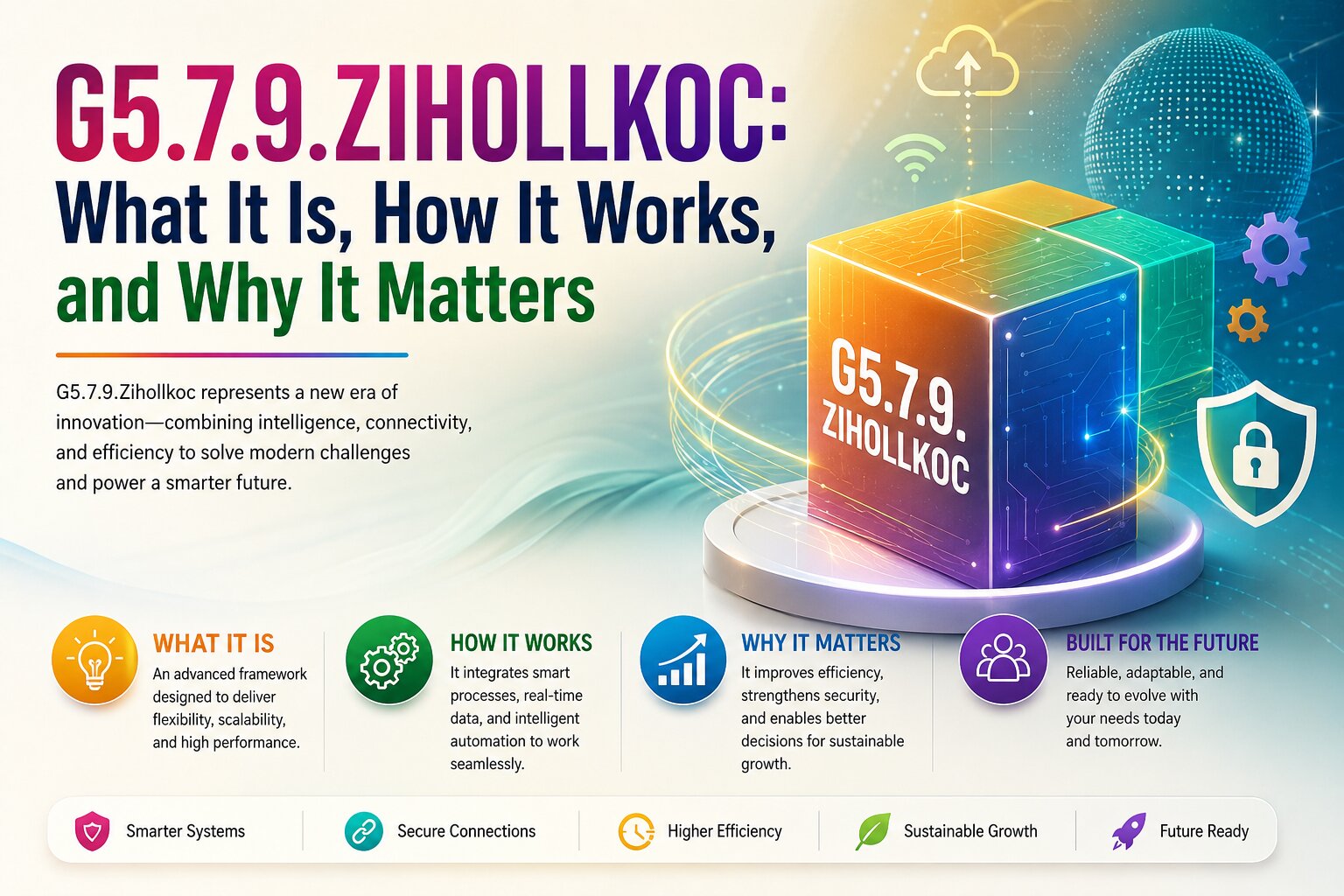
G5.7.9.zihollkoc confuses readers in the first reading. It appears to be a jumble of letters and numbers. However, it has a significant impact in the realm of digital systems and contemporary computing. g5.7.9.zihollkoc is a software version encountered by developers, system architects, and tech enthusiasts in their server logs, software builds, and data management platforms. Knowing what it is can better equip you with the ability to maneuver through today’s ever-evolving digital world. This article does a good job of simplifying both the concept and its application.
What Exactly Is G5.7.9.Zihollkoc?
G5.7.9.zihollkoc is a structured digital identifier. Systems employ it to precisely label, track and organize information. Consider it to be a software component’s barcode. Each segment has its own significance. The identifier cannot be used as a normal English word. Rather, it serves as a machine-readable tag to maintain organisation and efficiency in digital systems.
These kinds of structured identifiers are used regularly in version control systems, database management software, and software deployment pipelines. They’re used by developers on a daily basis without them thinking much about it. g5.7.9.zihollkoc is not an error or a threat – it is a carefully designed reference point that you are seeing in a log file or system report.
Breaking Down the Structure of G5.7.9.Zihollkoc
Each of g5.7.9.zihollkoc has a story. Let’s take it down to bite-size chunks.
The “G5” Segment
The “G5” prefix is usually used to denote the category or generation of the system. It indicates to the system to which platform or product family this identifier belongs. It’s a section in which developers can organize related components into a single section. It can make searching and filtering through gigabytes of data much quicker.
The “7.9” Portion
“7.9” is a numeric section, which denotes a versioning layer. Many software teams adopt semantic versioning which uses numbers to indicate the magnitude of changes to a software. The first number is likely to imply a major release. The second indicates a slight modification or improvement. They provide developers with instant visibility of where this build is in the development process.
The “Zihollkoc” Suffix
The alphanumeric tail “zihollkoc” is used as a unique identifier string. These strings are generated by systems to make sure that no two records have the same reference. Thus, data conflicts are avoided and tracking is accurate. Session tokens, API keys, and build hashes have similar uses in contemporary software environments.
How G5.7.9.Zihollkoc Functions in Real Digital Systems
The problem is that G5.7.9.zihollkoc just lies there in a database. It is actively involved in several core operations of software and system management.
Version Tracking
Software is updated several times weekly. Manual tracking of each version leads to chaos. Identifiers such as g5.7.9.zihollkoc do this automatically. Every build is stamped with a unique code in the system. If something goes wrong, teams can easily be taken back to any previous version in a matter of seconds. This saves hours of debugging time and a stable production environment.
Data Organization
Millions of data records are handled by large platforms. They organize and access data efficiently with structured identifiers. G5.7.9.zihollkoc is used for sorting records by generation, version and unique instance. This means that queries run faster and responses to the system are more reliable.
System Monitoring and Logs
In the event of something going wrong, engineers review system logs. The reference point for G5.7.9.zihollkoc is given in these logs. Engineers utilize it to pinpoint exactly what component has failed and when. This significantly cuts down identification and repair time of system problems.
Build and Deployment Pipelines
Today’s DevOps teams use automated pipelines to get software to market on time and reliably. Each deployment has an identifier, such as g5.7.9.zihollkoc. This enables teams to correlate deployments to code changes, test results and team members. There is enhanced accountability and traceability throughout the delivery process.
Why G5.7.9.Zihollkoc Matters for Modern Computing
Structured identifiers become increasingly more important as digital complexity increases. Today’s systems process more data, more users and more integrations than ever before. If we didn’t have systems that were clearly labeled, modern infrastructure would fall apart.
The notion of computing systems that “manage complexity” is a more general trend of the computing world that G5.7.9.zihollkoc is part of. Previous systems were based on incremental (sequential) numbering. Today’s systems require more sophisticated solutions. They must have identifiers that are uniquely identifiable and have context, and that can be used for filtering. G5.7.9.zihollkoc provides you with all the three in one small string.
This is one way to promote scalability too. As a company expands from thousands of users to millions, so does the data volume. Well-structured identifiers result in a smooth scalability of the system. Teams don’t have to completely redesign their data architecture. They just continue variations of patterns.
Common Misconceptions About G5.7.9.Zihollkoc
There are many people who have g5.7.9.zihollkoc and think it’s a problem. The following are some of the most common myths and they are debunked.
Myth 1: It Is Malware or a Security Threat
The binary g5.7.9.zihollkoc is not a malicious code. It is one of the standard identifiers for a system. The presence of such in a log or report should not indicate a breach. During regular use of the system, security professionals employ similar identifiers.
Myth 2: It Is Gibberish or a Typo
The string appears random, but has a purposeful logic. Each segment serves a function. These identifiers are not chosen randomly by engineers, but with a purpose.
Myth 3: Only Large Enterprises Use It
Structured identifiers are just as common among small development teams and startups as they are among large enterprises. This is a good way to use any version control, data management or log-based system. Relevance has nothing to do with scale.
Practical Applications Across Industries
Today, there are many industries that use G5.7.9.zihollkoc style identifiers.
Patient Management Platforms in Healthcare: Structured IDs for patient records, treatments, and device firmware tracking. It is essential to be accurate and identifiers will help to avoid any double or confused records.
Transaction systems identify each transaction. These tags are used by auditors to accurately track financial activity.
Cloud infrastructure management in e-commerce relies on using structured identifiers for managing server builds, database versions, deployment states in various regions around the world. Downtime is expensive and accurate identifiers enable a swifter response to incidents.
In manufacturing, the data streams are produced by IoT devices. Structured identifier is used to label sensor readings, equipment state and production batches in factories. This allows for predictive maintenance and quality control on a large scale.
How Developers Work With G5.7.9.Zihollkoc
The identifier g5.7.9.zihollkoc is not manually created by the developers each time. They are automatically generated by the build tools, version control systems and deployment platforms. The rules are set by the developer, and then the system is responsible for the rest.
There are tools available such as Git or Jenkins or Docker that can mark builds with structured identifiers. Others create their own generation scripts for their workflows. The rules remain consistent: each artifact is given an individualized, traceable label.
Final Thoughts
G5.7.9.zihollkoc isn’t just a jumble of letters and numbers! It is a sensible and organized way of dealing with the complexity of contemporary digital systems. From version tracking and system logs to deployment pipelines and large-scale data management, this type of identifier plays a vital role every day. For developers, system administrators, and tech enthusiasts, g5.7.9.zihollkoc’s meaning is essential for appreciating the unseen power that makes digital platforms function smoothly. When you next encounter g5.7.9.zihollkoc in a log or report you will know what it is.
FAQs
1. What does g5.7.9.zihollkoc represent in software development?
The identifier g5.7.9.zihollkoc is a structured identifier. It annotates particular versions, builds or data records for software systems. It is used by developers to monitor, structure, and conveniently access information on complicated platforms.
2. Is g5.7.9.zihollkoc dangerous or related to malware?
No. G5.7.9.zihollkoc isn’t malware. It is a standard digital identifier employed in the records of a system, version management, and data management tools. Just because you see it in a report or log, doesn’t mean it is a security threat.
3. Which industries commonly use identifiers like g5.7.9.zihollkoc?
Structured identifiers are used in a number of applications, including healthcare, finance, manufacturing, and e-commerce, all of which use identifiers that are similar to g5.7.9.zihollkoc. This type of labelling system is essential for any industry that has to deal with very large amounts of data, or software application buildings.
4. How does the versioning portion of g5.7.9.zihollkoc work?
g5.7.9.zihollkoc is semantic versioned. The first number indicates a major release. The second one is a minor update. They report the amount of changes introduced to a system or software build, working together.
5. Can small businesses benefit from using identifiers like g5.7.9.zihollkoc?
Absolutely. Identifiers are beneficial for small teams that maintain software versions, track deployments or organize data records. No matter the size of the team, the g5.7.9.zihollkoc-style code creates better traceability and error reduction.